The Logos does not illustrate astronomy. Astronomy is its material.
At the centre of the work are Fast Radio Bursts: extremely brief and powerful pulses of radio energy originating far beyond our galaxy. Their signals may travel for millions or billions of years before reaching Earth.
The Logos translates the structure of these otherwise invisible and inaudible phenomena into sound, allowing visitors to encounter cosmic time at a human scale.
Inside The Logos
Watch on YouTube ↗
Discover how astronomical data, spatial audio and the acoustics of Oulu Cathedral come together in The Logos.
Light-years become sound
Signals from the distant past
Fast Radio Bursts, or FRBs, are intense flashes of radio energy from deep space. First discovered in 2007, their origins remain one of contemporary astrophysics' compelling questions.
The signals used in The Logos come from real observational data. They are neither invented nor simulations of imagined cosmic sounds. The youngest signals represented in the work are approximately 50 million years old; the oldest, approximately eight to nine billion years old.
Age figures describe the time the signals have travelled, not necessarily the age of their sources.
From observation to perception
The sonification process
This is sonification and artistic transformation of observational data — radio waves are not ordinary sound waves travelling through space.
A space built for wonder
The cathedral as instrument
The Logos was created for the scale and acoustics of Oulu Cathedral. Its stone surfaces, vaulted architecture and long reverberation don't merely contain the artwork — they give the distant signals physical presence.
The installation uses a specially configured Genelec spatial system of eight loudspeakers and four subwoofers — a 4.4.4 arrangement — letting sound move around the listener, through the upper space and across the low-frequency field. The result can be heard throughout the cathedral, and physically felt in the body.
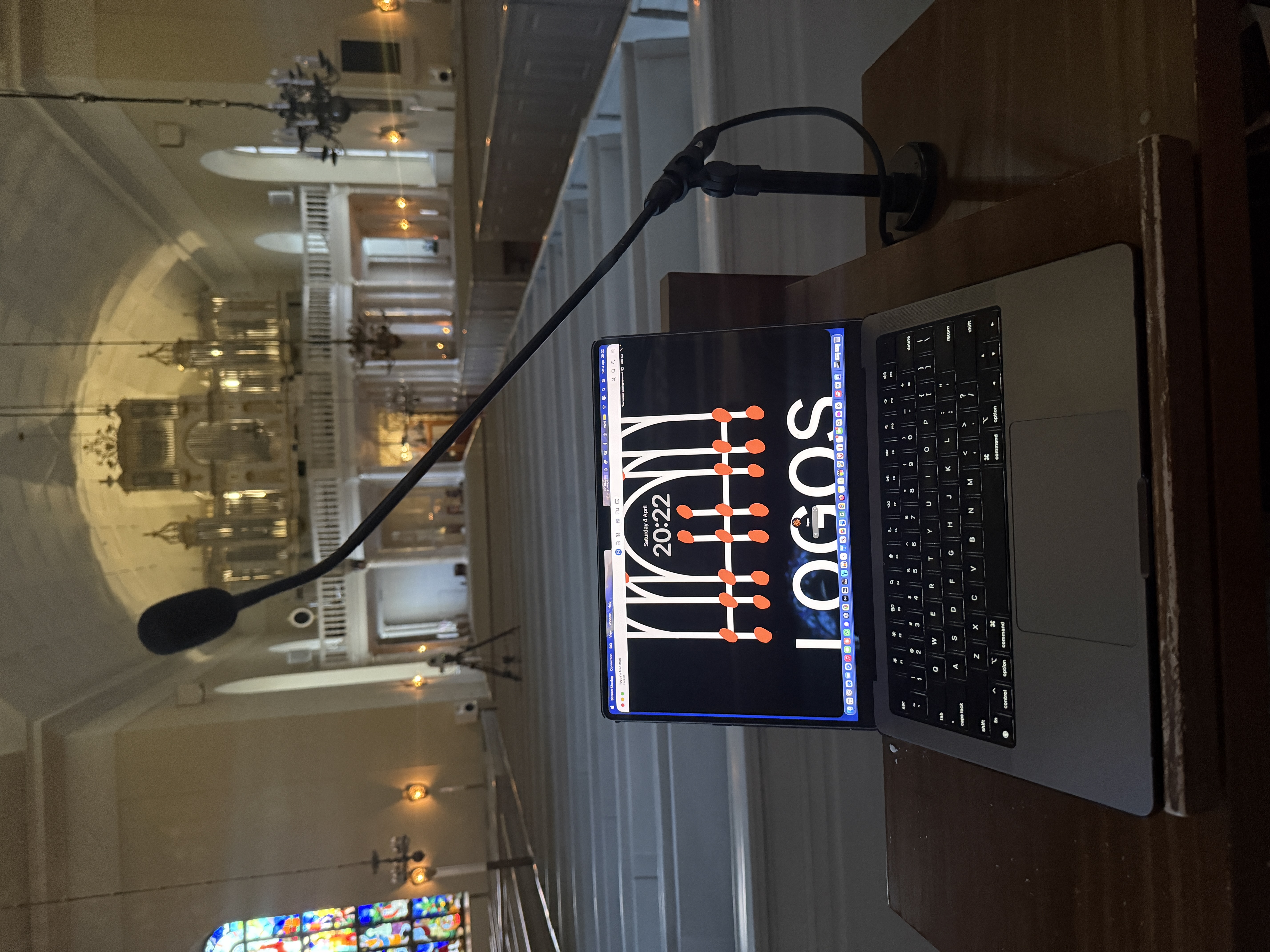
"You feel it in your stomach."
Oliver Larkin · software engineer
The silence between stars
The idea of Logos
The title comes from the Greek word λόγος — a term associated with word, reason and the ordering principle from which ideas of creation emerged.
The work's philosophical framework developed through Andrew Melchior's ongoing dialogue with philosopher Timothy Morton, whose writing on ecology, deep time and humanity's relationship with the non-human world helped shape the conceptual space of the installation.
The Logos asks what happens when phenomena measured by science are transformed into experiences capable of provoking reflection, emotion and wonder.
"The logos is the silence between stars — and that silence already lives inside the human mouth."
Timothy Morton · philosopher
Made across disciplines
Art, science & technology
Giving cosmic data a physical voice
The Genelec system
Eight Genelec loudspeakers and four Genelec subwoofers form the technical infrastructure through which The Logos occupies the cathedral — positioning sound at different heights, moving it between parts of the space, and spatialising bass frequencies usually reproduced through a single, non-directional channel.
The loudspeakers don't simply reproduce a soundtrack. Together with the building's acoustics, they let the cathedral itself participate in the work.
A daily encounter with deep time
Experience the work
Kirkkokatu 3 A, Oulu, Finland
Opening times may change around services, events and cathedral activities. Check the official programme before travelling.
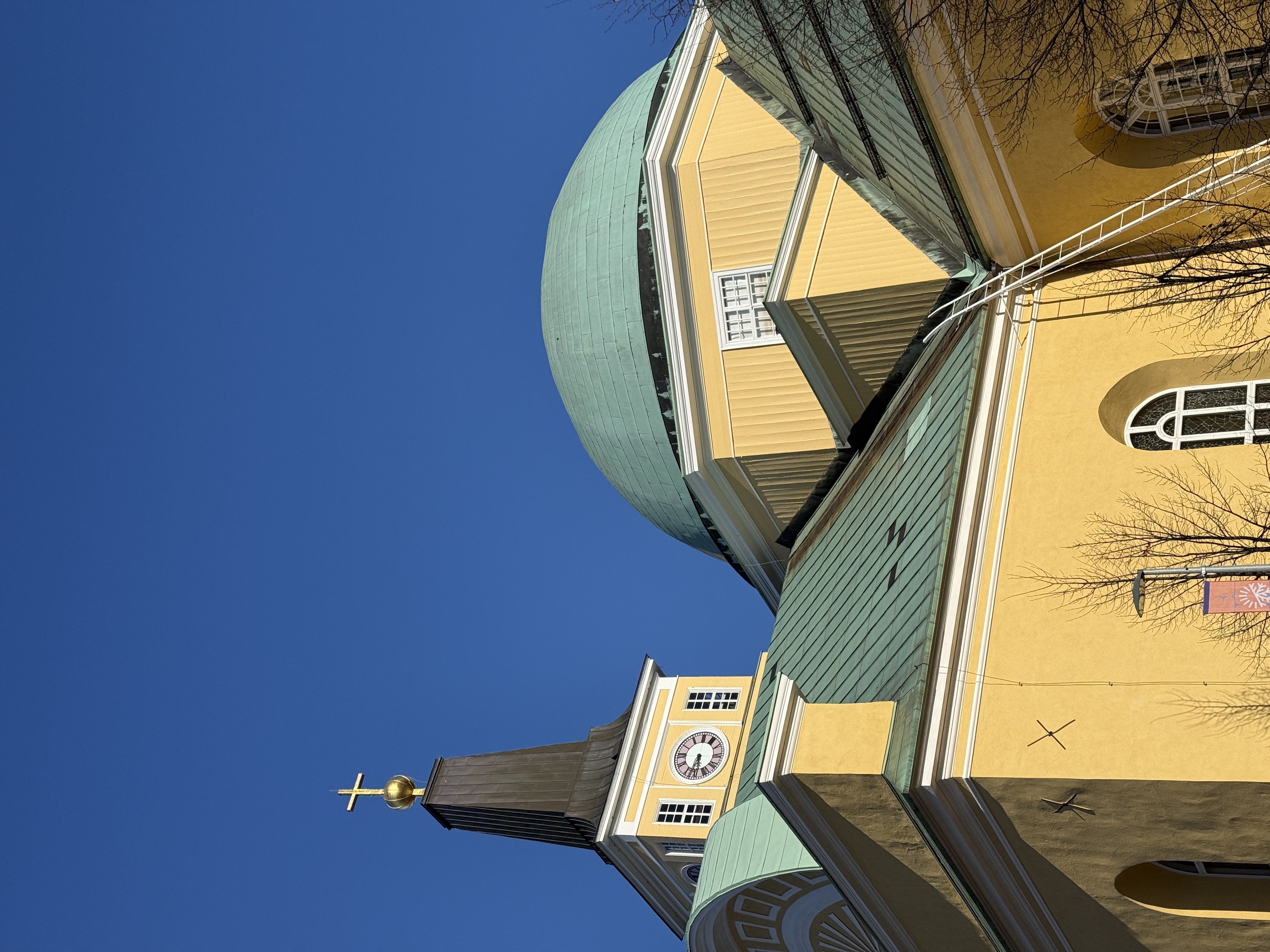
Something very far away, a very long time ago, released a burst of energy. It crossed the universe. Now it can be heard inside a cathedral.
The Logos turns cosmic distance into human presence.